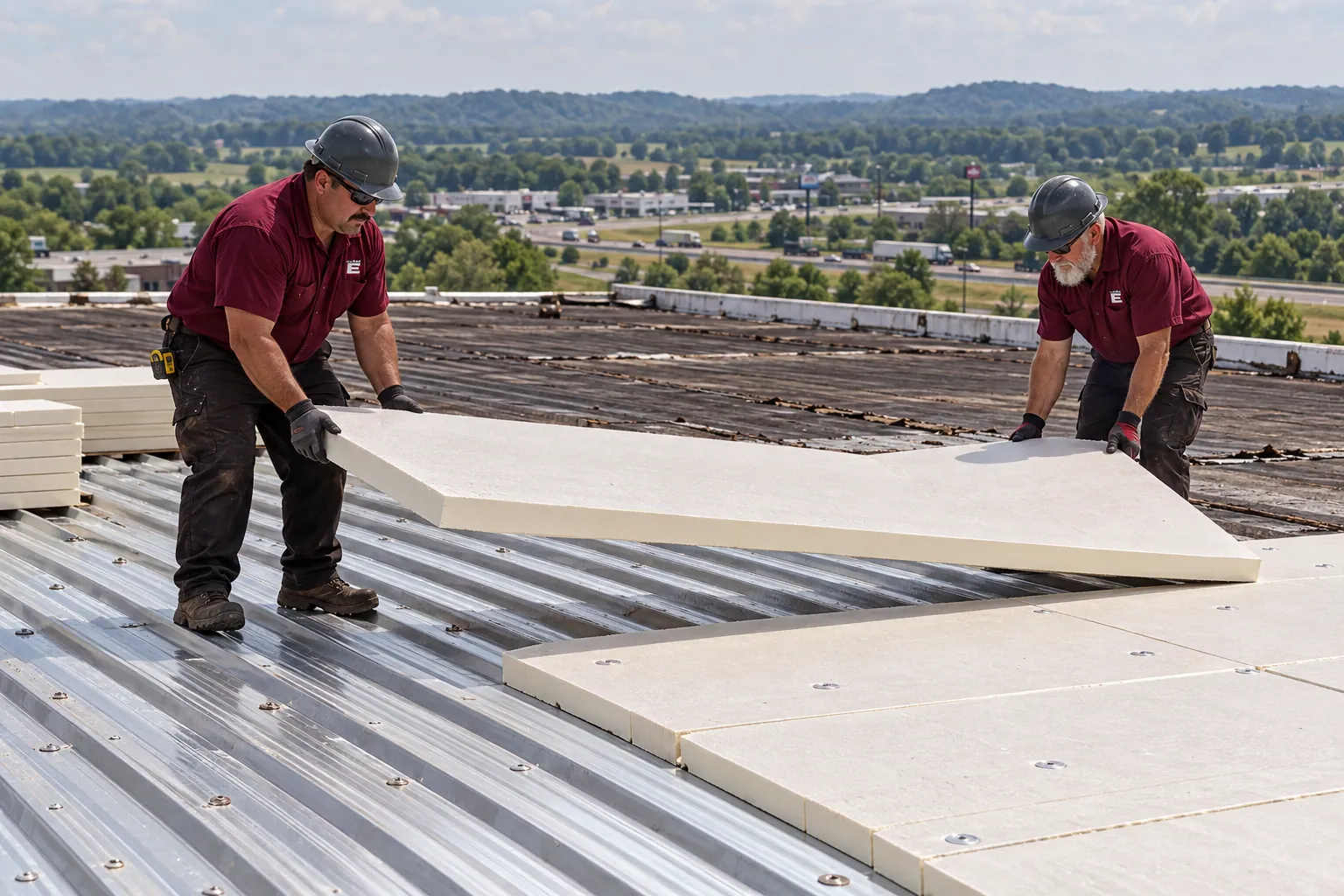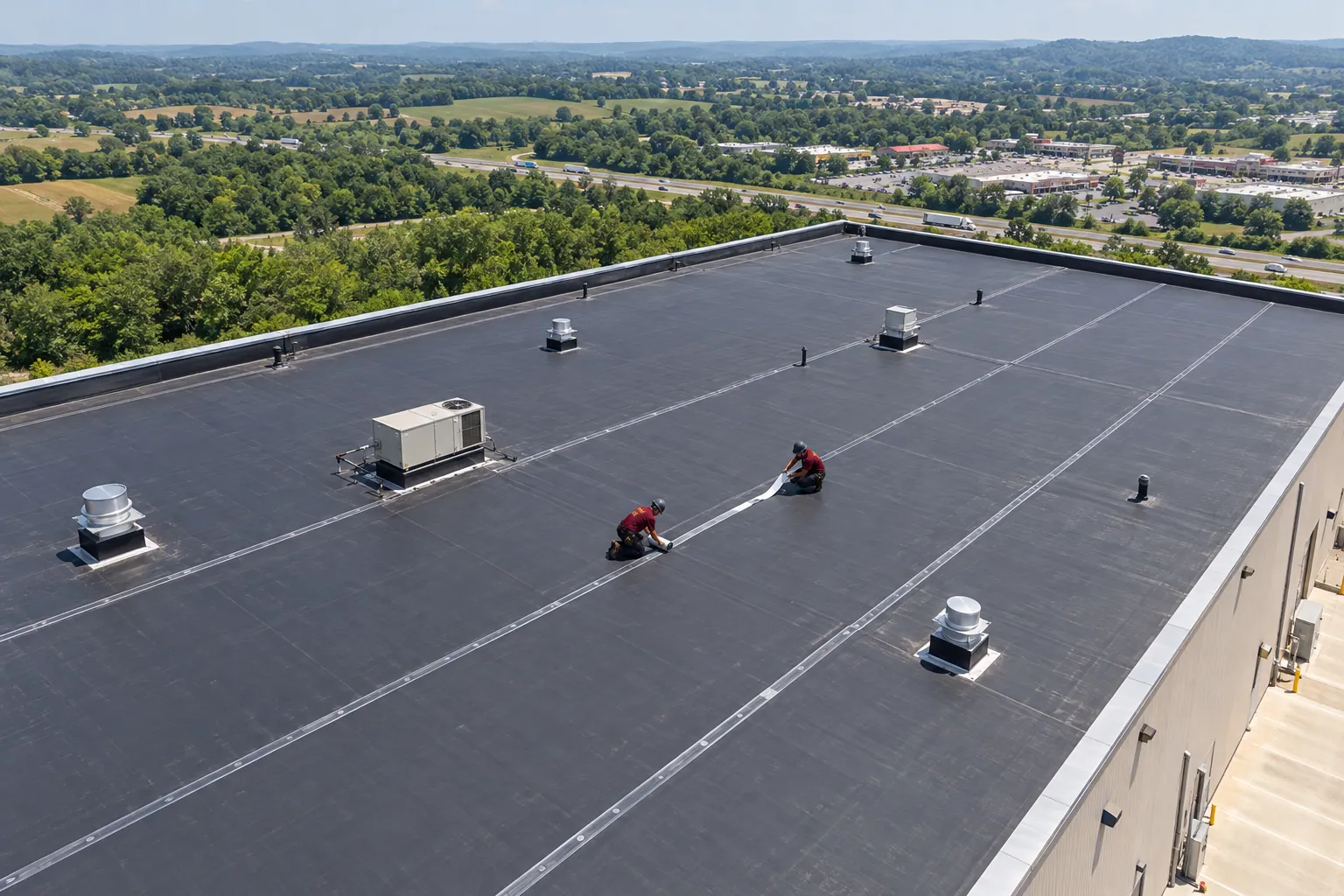
Roofer in a logo uniform rolling a taped seam on a black EPDM rubber roof

Elizabethtown EPDM Roofing Contractor

Extend the Life of Big, Plain Roofs With Flexible Rubber Sheet

As an Elizabethtown EPDM roofing contractor, we lay wide rubber sheets with taped, primed seams on large flat roofs, schools, churches, and older plants.

  • Taped And Primed SeamsRolled to set the bond
  • Wide SheetsFewer field seams
  • Flexible In ColdHandles freeze-thaw
  • Cover Board Under ItTakes hail impact

Is This Roof A Fit for EPDM?

Picking an Elizabethtown EPDM roofing contractor often starts with one question: black rubber or a white membrane. These five points settle it.

Black EPDM

Synthetic rubber, usually black, in large sheets.

Seams
Taped and primed, then rolled
Surface
Absorbs sunlight and runs hot in summer
Best On
Heated storage with little cooling
Weak Spot
Adds cooling load on air-conditioned space
Options
White-on-black EPDM for a reflective face
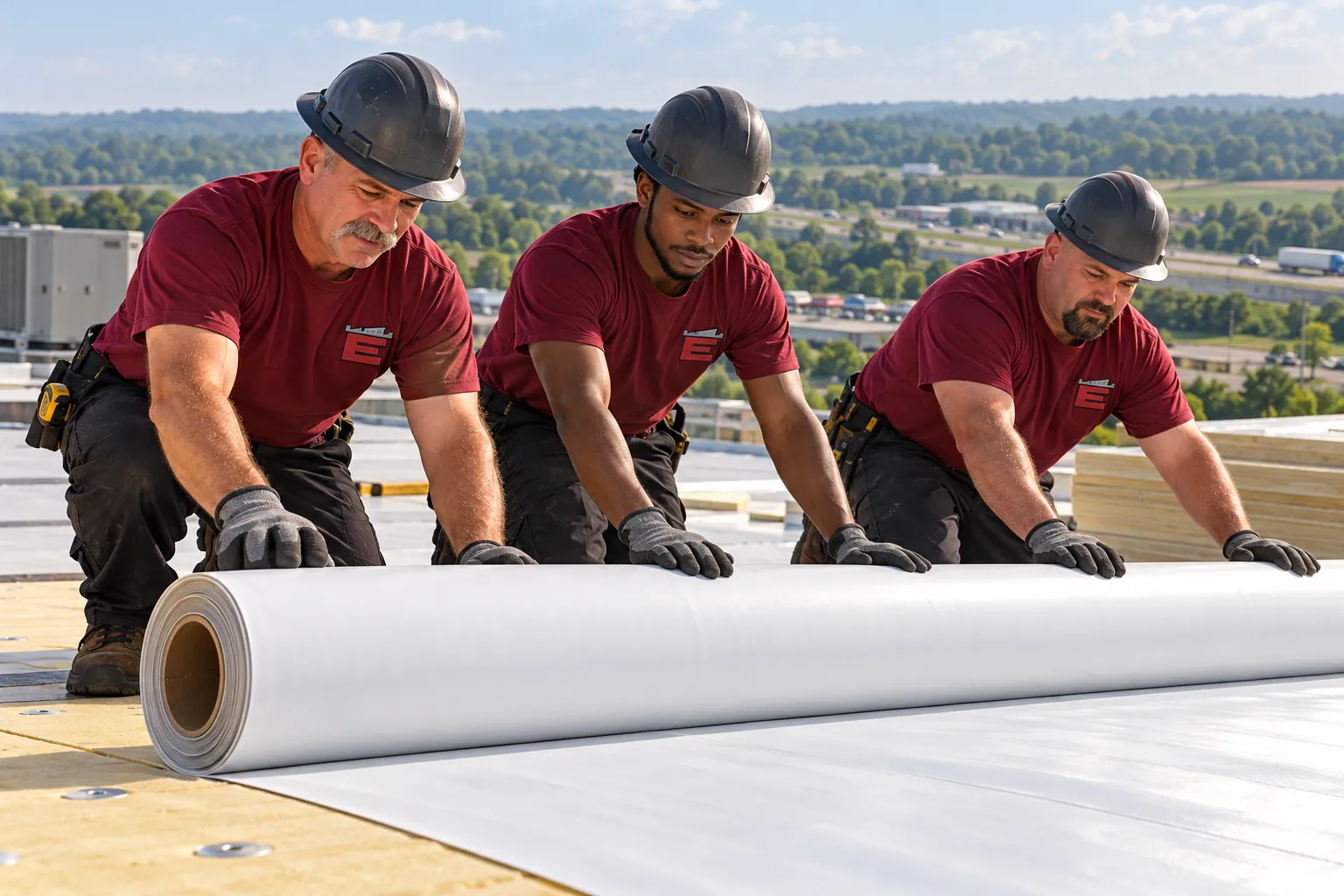
White TPO or White EPDM

A reflective surface for buildings that run cooling.

Seams
Welded TPO or taped white EPDM
Surface
Reflects much of the sun's heat
Best On
Air-conditioned offices, retail, and cold storage
Weak Spot
Gives up a little winter solar warming
Options
Compare ratings in the CRRC directory

EPDM Roofing Problems Found in Elizabethtown

Rubber roofs fail in a few predictable places, and most of them sit at the edges and the seams rather than out in the field.

Seams

Open Lap at a T-Joint

Seams laid over damp primer or dusty laps are the ones that open, often at T-joints where three sheets meet without a cover patch.

Punctures

Cuts From Dropped Tools

Hail rarely cracks rubber, but screws, metal shavings, and dropped tools near rooftop units punch straight through the sheet.

Edges

Wind Lift at the Perimeter

Wind pulls EPDM up at the edge first, so a loose cleat, sparse fastening near corners, or a failed parapet cap lets the sheet billow.

Walls

Sheet Pulling From Walls

Older rubber that shrinks pulls flashing away from walls and curbs, leaving a gap at the base where water runs behind it.

EPDM Roofing Options for Elizabethtown Buildings

EPDM is held down three ways, and the deck and structure decide which one fits your roof.

Fully Adhered EPDM

Bonding adhesive over a cover board makes a smooth, wind-resistant roof and suits roofs crowded with rooftop units and exhaust fans.

Repairs on existing EPDM

Mechanically Fastened EPDM

Plates through the laps go down quickly on steel decks, with tighter fastening rows near corners where wind uplift on the sheet is strongest.

Flat roof replacement

Ballasted EPDM

River stone or pavers hold the sheet on structures built for the added weight, behind parapets tall enough to keep the stone in place.

Compare all services

What a New EPDM Roof Gives Your Building

Rubber sheet earns its place on big, simple roofs, and here is where that shows up.

On The Roof

Fewer Field Seams

Large sheets cover a wide roof with fewer laps, and fewer laps means fewer places for water to find a way under.

Movement Without Cracking

The rubber stretches as the building moves and stays flexible through Kentucky freeze-thaw swings in winter.

Inside The Building

Hail Taken by the Cover Board

Rubber bends under hail and the cover board below absorbs much of the force, so the insulation over offices and classrooms stays intact.

Warmer Heated Storage

On buildings with heating and little cooling, black EPDM gives up less heat to the sky through the winter.

For Planning And Budget

Recover Without Tear-Off

A dry existing roof can take a new cover board and EPDM on top, which avoids hauling off the old layers.

Straightforward Patches

Damaged areas take a primed, taped patch cut from matching rubber, which keeps future repairs simple.

Rubber Roof Lifting at the Edges?

Call and describe where the sheet is loose and whether the edge metal or parapet cap has moved, and the visit starts there.

Steps From Your Elizabethtown EPDM Roofing Contractor

Each EPDM job runs in this order, with seam work done only on dry, primed laps.

  1. Inspect Your Roof

    On The Roof

    Walking the existing roof, we look for open laps, cuts near units, loose edges, and shrinkage at walls, and core cuts show the layers and any wet insulation.

  2. Pick the Hold-Down Method

    Paperwork

    Fully adhered, mechanically fastened, or ballasted: the deck type, the structure's capacity for added weight, and the parapet height decide which one goes on.

  3. Prepare the Deck and Cover Board

    On The Roof

    Wet insulation comes out, deck repairs are made, and a cover board goes down so hail and boot traffic land on a firm surface.

  4. Lay and Tape the Seams

    On The Roof

    Laps are scrubbed of dust and talc, primed on both faces, taped, and rolled toward the edge, with cover patches over seam ends and T-joints.

  5. Flash Edges and Curbs

    On The Roof

    Curbs, drains, and walls get cured or uncured EPDM flashing, and the edge cleat and corner fastening follow the system maker's wind requirements.

  6. Walkway Pads and Records

    Paperwork

    Pads go down on the paths to units, hatches, and ladders, and you get photos of the seams and edges as built.

Membrane Choices Next to EPDM

Two neighboring services share the roof walk with EPDM.

Roofers wearing the company logo heat-welding a white TPO membrane seam on a commercial roof

TPO Roofing

Air-conditioned offices and retail with rooftop units across the field often fit welded white TPO instead of black rubber.

TPO roofing
Roofing crew in logo uniforms tearing off an old low-slope roof down to the deck

Flat Roofing

When the existing roof holds wet insulation, the job becomes a flat roof replacement with tear-off and tapered boards.

Flat roofing

EPDM Rubber Roof Questions for Elizabethtown Owners

Answers about rubber sheet, seams, and protection on Kentucky roofs.

Where does an EPDM rubber roof make sense in Elizabethtown, KY?

On big, simple roofs with few penetrations, such as storage buildings, older plants, schools, and churches with flat sections. EPDM stays flexible in cold weather, which suits Kentucky winters, and it works as a recover over a dry existing roof with a new cover board between the layers.

How are EPDM roof seams taped?

With primer and seam tape instead of heat. The lap is scrubbed clean of dust and talc, both faces get the tape maker's primer, the tape goes in with its release paper pulled, and the seam is rolled firmly toward the edge. Seam ends and T-joints get a cover patch.

Black vs white EPDM: which suits a Kentucky building?

It follows how the building is used. Heated storage with little cooling often fits black EPDM, while air-conditioned offices, retail, and cold storage gain more from a reflective white surface. A reflective roof gives up a little winter solar warming, so the choice weighs both seasons.

How do you protect an EPDM roof from hail and foot traffic?

Put a cover board under the sheet instead of bare insulation, lay walkway pads on the paths to units and hatches, and use thicker or reinforced sheet where service traffic is heavy. After a hailstorm, walk the roof and look for cuts near metal edges and soft dents in the insulation.

How is an EPDM roof held down on the deck?

Three ways: fully adhered with bonding adhesive, mechanically fastened with plates through the laps, or ballasted with stone or pavers. Adhered sheet over a cover board suits roofs with many units, fastening goes quickly on steel decks, and ballast needs a structure and parapet built for the weight.

Can a damaged EPDM roof be patched instead of replaced?

Often, when the damage is local and the insulation is dry. A cut or open lap is cleaned, primed, and covered with a taped patch of matching rubber. Shrinkage pulling flashing off many walls, or soft insulation across wide areas, points toward a new roof.

Book an Elizabethtown EPDM Roofing Contractor

Start with a roof walk, then see the hold-down method, seam plan, and flashing details before any sheet is ordered.

Call Us (930) 201-3950